
The Image That Never Fades: A Dressing Room in Malibu and the Myth of American Gigolo
A tight medium shot sets the scene. The year is 1980, and the Californian light filters in through the Venetian blinds of an apartment that smells of lacquer, avant-garde design, and new money. On an immaculate bed lies a display of silk shirts, perfectly aligned, arranged in a chromatic gradient running from pearl grey to midnight blue. Before the mirror, a magnetic, youthful Richard Gere, his melancholy gaze seemingly rehearsed a thousand times, carefully selects a Giorgio Armani suit while, in the background, Blondie’s synthetic music marks the pulse of the decade.
It is the perfect iconography.
The imperturbable dandy crossing Sunset Boulevard at the wheel of a black convertible, embodying an aesthetic and industrial standard so nearly unreal that, even today, four decades on, it remains the first image summoned by the word gigolo. The first image, though, is not the first story: the figure has existed for two thousand years and changed its name in every age.
That image is the common ground. It is the visual refuge where the viewer feels at ease because the rules of the game are familiar: luxury as armour, beauty as currency, and seduction stripped of any trace of human vulgarity.
Hollywood sold the world the idea that the male companion was an automaton of pleasure, one who never suffered indigestion, an ill-timed muscle cramp, or an existential doubt halfway through the act. An impeccable fantasy, yes, but designed with the coldness of marble. How many young men of the era must have mythologised the profession while looking at those perfectly ironed shirts? And how many people must have built their real expectations upon a mannequin from a cinematic catwalk?
The Catalogue of Caricature: The Moral Price the Script Makes the Male Companion Pay
Yet once the entertainment industry exhausts the aesthetic of the dandy, the screen needs to seek out conflict. If we step down from the pedestal of auteur cinema and enter the terrain of mass consumption of television series and afternoon thrillers, the sophisticated mirror of American Gigolo shatters into a collection of crude, moralising clichés.
Popular culture has always swung between two absolute extremes when portraying this trade: glamorous, aspirational fascination, or the most brazen and comic parody. Against the myth of the unattainable seducer, film and television comedy has preferred to exploit the more tender, awkward and comic side of the profession. We think at once of certain comedies of errors, or of endearing characters from contemporary Spanish cinema, where ordinary men try, and utterly fail, to emulate those studs from the fashion magazines, grappling with absurd situations in which the clients completely derail the established script.
But we should not stop at the easy laughter. Because when you look at how these stories really end, the comic ones and the serious ones alike, what is it that almost always awaits the gigolo once the show is over?
The real pattern is not laughter; it is punishment.
A survey of film and television reveals an uncomfortable constant: in a surprisingly large share of popular fiction, the male companion ends up paying a toll in blood, humiliation or imprisonment.
This is not a mere dramatic choice to generate suspense, but a subtle mechanism of narrative control. The screen resists portraying the normality, or the financial and emotional success, of this independent worker. Instead, the screenplay prefers to build a cautionary parable, implicitly decreeing that any man who chooses to profit from his magnetism outside the traditional channels of marriage or conventional employment is condemned to a tragic fate.
The cinematic system needs to restore social peace by dragging the rebel back into the gutter, demonstrating that unconstrained male beauty always comes with a violent expiry date.
-
There is the cold manipulator, the social climber, in the style of the series Toy Boy, caught in a web of ambition where the body is merely a disposable political weapon.
-
There is the emotional swindler, that white-collar criminal who seduces vulnerable heiresses to drain their bank accounts, a trope worn to exhaustion in sensationalist investigative reports and in afternoon suspense films.
-
There is the figure degraded by farce, as in Deuce Bigalow: Male Gigolo, where the trade is reduced to a chain of grotesque misunderstandings designed to neutralise any threat to the male viewer.
On the big screen, the gigolo almost never gets a happy ending. If the plot moves forward, the screenplay forces him to pay a morality tax: he ends up behind bars, or gagged in the boot of a car, or murdered in cold blood simply to move the detective’s investigation along. It seems an unwritten rule in the offices of the Hollywood studios: the transgression of trading on male attractiveness must be punished before the closing credits roll.

The Hidden Mechanism: The Real Taboo Is a Woman Free to Desire
Why this almost obsessive insistence on penalising the man who sells his time? Why does cinematic fiction need the gigolo to always end up as either the villain or the victim?
The answer is not found in the laws of the labour market, but in the foundations of our social hypocrisy.
The gigolo is, in truth, the lightning rod for a far greater cultural short circuit. It is infinitely more comfortable to condemn the man, to label him a dangerous rogue or a heartless creature, than to stop and look at what his figure exposes in broad daylight: the desire of the person who hires his services.
It is worth asking, then: why has society accepted for millennia that a man may pay for company, yet raises an eyebrow when a woman decides to do exactly the same?
The screen punishes the professional because what truly unsettles is the profile of his clientele.
A woman who decides to buy time, company, and pleasure as readily as she might purchase any other premium experience blows apart the foundations of the traditional narrative.
Various studies of commercial intimacy and paid companionship have identified motivations related to autonomy, curiosity, emotional wellbeing, and the desire to keep control over the terms of the encounter. [1] The most common profile is that of an economically independent woman with the maturity to prioritise her own wellbeing. [2]
For some, the encounter is a form of empowerment; for others, trapped in the tyranny of having to lead and decide every minute of their public lives, the real luxury lies in doing precisely the opposite: stepping away from the controls and, for once, not having to decide anything.
And yet cinema tolerates female desire only if it passes through the filter of sugar-coated romance, conventional marriage, or dramatic vulnerability. A woman who seeks pleasure for pleasure’s sake, who demands attention, intelligent conversation, and exclusivity on her own terms and without owing anyone an explanation, remains the true unresolved taboo of Western culture.
Punishing the gigolo on screen is modern puritanism’s most cowardly way of disciplining women who dare to desire freely.
— Alexander
By punishing the gigolo in the final act of the film, the screenplay breathes a sigh of relief. It restores the established order, closes Pandora’s box, and quietly tells the audience that straying beyond the boundaries of traditional respectability has a price. He pays the price in fiction so that women will not dare cross the line in reality.
The Blind Spot: What the Long Take Cannot Capture About Real Intimacy
This systematic bias carries an enormous cultural cost: it erases the lived reality of the profession from the picture entirely. Cinema has an alarming lack of erotic and emotional imagination; it needs urgency, testosterone-heavy close-ups, artificial sweat, and constant dramatic conflict to keep the viewer glued to the seat.
It permanently confuses gymnastics with complicity.
After years working as a companion, I have learned that the moments that truly define an encounter rarely resemble the ones cinema deems worthy of a camera.

No camera would ever film the cork that shoots out at precisely the wrong moment, in the middle of an atmosphere calculated down to the millimetre, and makes both people at the table jump: that tiny act of sabotage punctures the pose of the infallible seducer in an instant, and the script has no use for it.
For that very reason, the competent, measured, and mature version of the profession remains invisible to the cameras. The lived reality, the part that truly matters, lacks the dramatic spectacle that a two-minute trailer demands.
How do you film the value of absolute discretion? What kind of special effects are needed to portray an hour of attentive listening over a glass of wine, during which a woman sheds the armour of her daily responsibilities and breathes with relief because she finds herself in a discreet space, free of judgement?
Television and cinema show the noisy periphery because they do not know how to film the intimate centre.
They fail to understand that, in high-end encounters, the physical act is usually only the final chapter of a story whose first lines are written much earlier, through conversation, social ease and mutual rapport.
By feeding the caricature of the infallible seducer or the unscrupulous swindler, the media have created a giant blind spot, hiding the fact that the true currency in this trade is not flesh, but the quality of the time spent together.
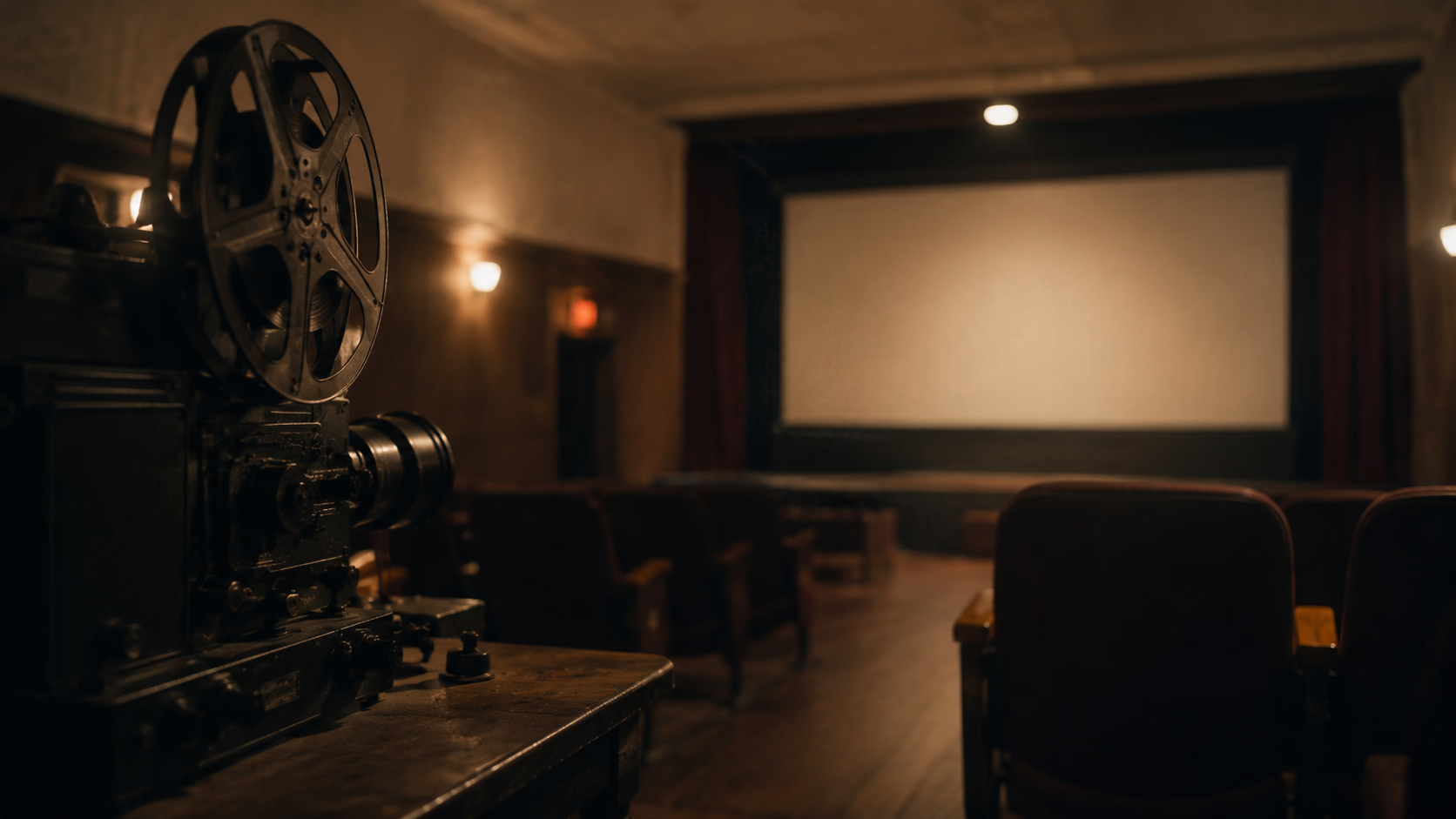
Refocusing: The Reality Behind the Lacquer
When we switch off the projector, take down the spotlights, and wipe away the layer of varnish Hollywood has left over the trade, what remains is neither a lament nor an apology. It is not about adopting the comfortable posture of a misunderstood profession seeking public validation. It is, quite simply, about adjusting the lens.
And adjusting the lens begins with not idealising: as in any profession built on trust, there are conscientious professionals, mediocre practices and experiences that vary widely. Fiction, quite simply, rarely takes an interest in that ordinary zone where the work rests on attentive listening and clear boundaries.
Once Richard Gere’s silk shirt and the cheap suspense of television drama are stripped away, what emerges from behind the façade of the picture-perfect seducer is something far more ordinary and, at the same time, far more serious.
What remains is a profession built not on the adrenaline of the underworld or the unreal luxury of Malibu, but on an understanding of human behaviour, the management of expectations, and respect for the other person’s freedom.
Behind the myth of the unattainable seducer, there is always a flesh-and-blood professional who knows how to respond to the amusing, complex, and wonderful eccentricities of those who choose to claim their own pleasure. A facilitator who understands that hedonism is not a sin for which one must pay in the final act of a film, but one of the oldest and most sophisticated forms of courtesy.
The industry will go on producing its predictable scripts, because normality does not drive ratings; reality, fortunately, continues to be written behind closed doors, with the lights dimmed and no one directing the scene.
And let us be honest: arranging Armani suits by colour is all very well. But bursting into laughter together while trying to decipher the unpronounceable dishes of a gourmet menu has an altogether different flavour.
Author's note
This article combines an analysis of the cinematic and television representations of the trade with my professional experience as an independent companion. The cited sources provide context for the social aspects of the phenomenon; the interpretations and opinions are my own.
Cited sources
- Kingston, S., Hammond, N. & Redman, S. (2021). “Transformational sexualities: Motivations of women who pay for sexual services”. Sexualities, 24(4), 527–548. — Motivations of women who pay for companionship: agency, autonomy, and control over the terms of the encounter. ↩
- Berg, R. C., Molin, S. B. & Nanavati, J. (2020). “Women Who Trade Sexual Services from Men: A Systematic Mapping Review”. Journal of Sex Research, 57(1), 104–118. — A systematic review of 46 studies: the profile of the female clientele tends to be that of mature, economically independent women. ↩
Works mentioned
American Gigolo (1980), dir. Paul Schrader. · Toy Boy (2019, series). · Deuce Bigalow: Male Gigolo (1999), dir. Mike Mitchell.