
The commerce of affection, of time and of male desire is a flawless mirror of the transformations of Western morality. Often eclipsed by the historiography of female prostitution, the sale of company by men has travelled winding, ambiguous roads. It has passed from the gymnasia of classical Antiquity and the gilded corridors of courtly power to the margins of urban clandestinity, only to arrive today at the digital sophistication of premium-service apps. This evolution speaks not only of carnal or economic exchange. Fundamentally, it narrates the transformation of masculinity, the evolution of leisure, the liberation of desire and the complex management of attention in contemporary society.
Have we ever stopped to ask why it makes us so uncomfortable to imagine a man charging for his attention, when society has normalised other commercial exchanges tied to care or entertainment? The short answer takes us back to centuries of structures in which the male was to be solely the provider and never the object of consumption; and breaking that pattern demands that we reread history from a perspective free of prejudice.
When we think of male prostitution, the imagination travels straight to a contemporary setting: the internet, dating apps, hotels and luxury travel. Carefully crafted profiles. Professional photographs. In short, a phenomenon that seems to belong exclusively to the twenty-first century.
But what if that image were only the last chapter of a far longer story?
Classical roots: desire as status in Greece and Rome
To understand the origin of this figure, we must go back to the foundations of our civilisation. In ancient Greece the exchange of asymmetrical favours between men was not merely normalised: through institutionalised pederasty it was part of the educational and social fabric of the elites. Yet when money mediated directly, the scene changed. There were the pornoi, young men, often slaves or foreigners, who sold their company at banquets and symposia. The most sought-after were valued not for their looks alone: their wit and command of conversation were prized before the most influential citizens of the polis. Even so, the direct sale of male pleasure carried a heavy stigma: the citizen who prostituted himself could lose his civic rights, while the more honourable form of affection between men was reserved for the eromenos, the beloved youth of the pederastic bond[1].
The best-placed among them could become catalysts of male social and aesthetic life.
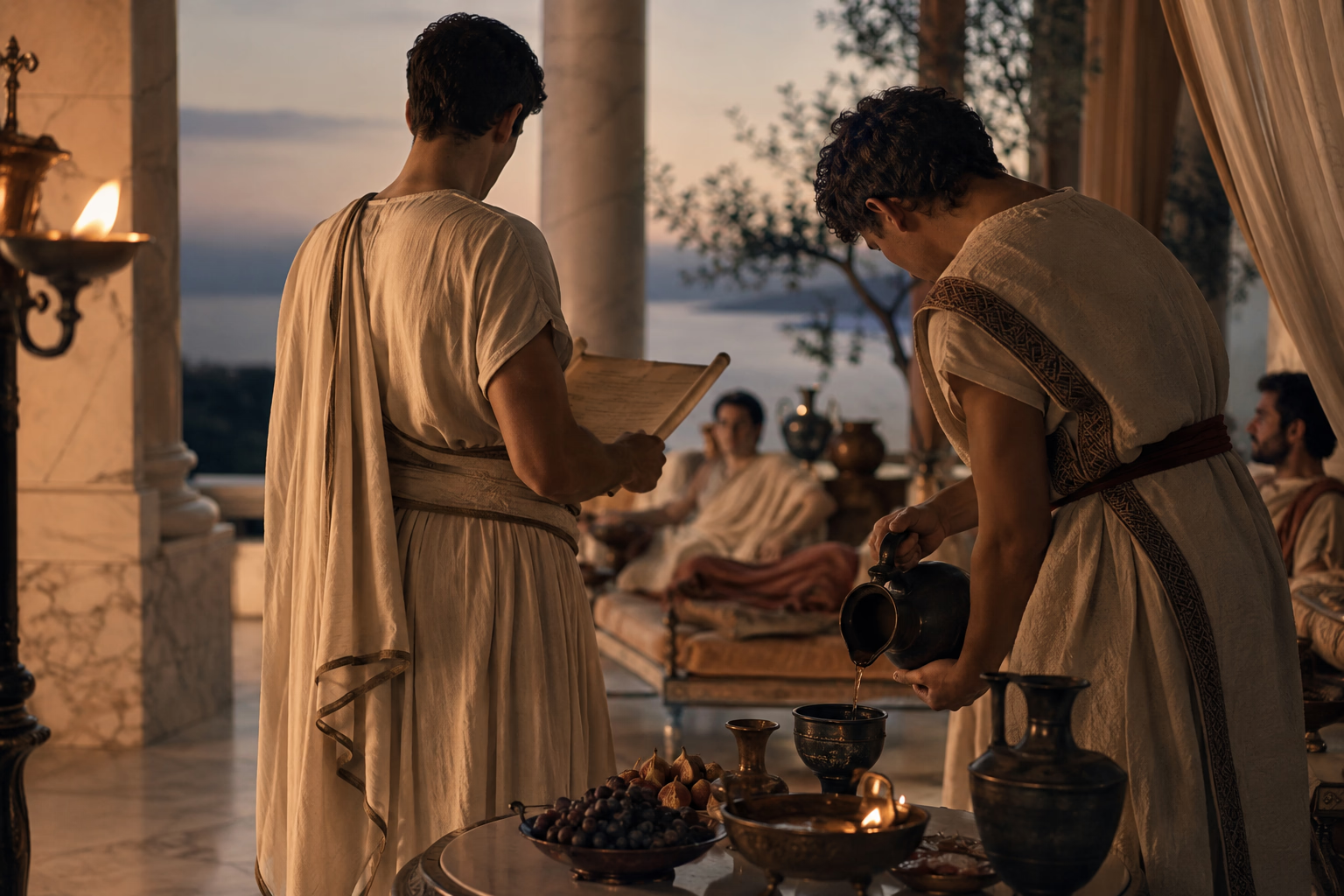
For its part, the Roman Empire took this commerce onto far more pragmatic, legislated and unsparing ground. In Rome, sexuality was a question of status and power, not of orientation[2]. High-ranking Roman citizens actively sought the company of refined young men to display their wealth and sophistication in the baths and at private feasts. The freed slave or the foreign youth who knew how to move within the circles of power used his allure as a bargaining lever.
To what extent was desire the real engine of these exchanges, or was it rather a game of social prestige before the eyes of rival patricians? The border between submission and strategy was extremely thin, but already in classical Rome a historical constant was taking shape: the male companion as a luxury article reserved for those who held power and money.
The body as political currency: the age of courtiers and favourites
With the fall of the classical world and the passing of the centuries, the physical favour of a young and attractive man ceased to be governed by civil law and moved into the shadows of the royal palaces. Across early modern Europe, from the Versailles of the Louis to the Madrid of the Habsburgs and the Bourbons, the figure of the favourite, the favoured courtier, frequently brushed the limits of carnal and affective commerce. Direct access to the monarch or to the high-ranking aristocrat depended on a studied and demanding blend of erudition, physical dexterity, refinement in dress, verbal sharpness and submission in intimacy.

Looking back analytically, where did diplomacy end and affective labour begin? In this courtly context the male body functioned as a genuine dynastic instrument. The exchange was duly dressed in protocol, lofty poetry, artistic patronage and courtly rhetoric. The profit of these unions was measured not in monetary terms but in the survival or dazzling social ascent of entire families. And yet history is full of favourites fallen from grace. This laid bare the enormous fragility of a business in which youth and aesthetic grace were the only collateral available. The moment a younger rival appeared, or the protector changed his mind, the courtier found himself stripped of all value, banished and erased from the official chronicles.
With the arrival of the Industrial Revolution and the consequent collapse of the old aristocracy, this courtly model dissolved. Commercialised male desire descended from the palaces to the damp outskirts of the growing cities. Through the nineteenth century and much of the twentieth, the great European capitals saw a deeply marginal street prostitution flourish, bound to urban misery and to migration from countryside to city.

Under the punitive gaze of the State, these men were severely punished by vagrancy laws and by the criminalisation of sodomy, as well as by the moral codes of hygienism[3]. The man who sold his body no longer inhabited velvet salons nor conversed in Latin; he barely survived in the dark alleys of the great trading ports or near the railway stations. His reality was no longer political influence but survival in the face of the double stigma of selling sex and criminalised homosexuality.
The metamorphosis of the concept: from the elegance of the gigolo to the companionship service
In the mid-twentieth century, consumer society and mass tourism began to demand a refinement of labels to segment a market built on appearances. It was then that the term gigolo burst into the international vocabulary. This word of French origin originally evoked the figure of the young, sophisticated, impeccably mannered man kept financially by an older woman of high social standing[4].
The figure of the man who offers his company in exchange for financial compensation has changed its name as many times as the society around him has changed.
Labels change with time, but the human need for company always finds a way to reinvent itself.
The gigolo was no longer an outcast of the gutter; he was a seducer in the luxury hotel salon, a skilled dancer in the ballrooms of the great ocean liners, a companion who collected his fees in the form of jewels, bespoke tailoring, exotic travel and long stays on the Côte d’Azur. His market value lay not in physical urgency but in his capacity to confer social prestige, youth and vitality on his client, in a world where a mature woman, single or widowed, suffered social emptiness. It is the image that cinema would later fix for good, and has gone on punishing ever since.

The contemporary male companion has ceased to be a mere object of aesthetic desire and become a professional manager of emotional wellbeing and exclusive attention. This is the great backbone of his historical evolution.
Today the Anglo-Saxon term escort has almost entirely displaced the earlier designations. This shift is no mere cosmetic marketing strategy; it implies an absolute redefinition of the nature of the service rendered. Today’s escort presents and trains himself as a professional of complete companionship. The hourly or full-day fee no longer covers only intimacy behind closed doors, but far more complex and subtle skills: the eloquence and poise of a high-level business dinner, the empathy after a difficult personal chapter, or the assurance of attending a prestigious social event where image is everything. The modern client seeks, fundamentally, a select and exclusive experience in which sex becomes a secondary element, or entirely optional, within the agreed experience.
The business in the age of the algorithm: the digitalised reality
In Spain, the sector has undergone an irreversible revolution over the past decade; digitalisation has removed the traditional intermediaries, turning the professional into the absolute manager of his own security and digital brand, albeit at the cost of a constant demand for aesthetics and public relations.
Moreover, the consumer profile in Spanish society has also changed markedly. Meeting a male companion in a great city like Madrid or Barcelona is no longer perceived as an unconfessable secret, the exclusive preserve of a decadent aristocracy. It has become an option of sophisticated leisure, of wellbeing and of preferential attention, sought by high and highly diverse socioeconomic profiles. In a social context where professional rhythms scarcely leave room to build stable emotional relationships, paying for quality time and dedicated, exclusive attention is seen as a functional, hedonistic alternative, free from the emotional ties of everyday life.
Yet it is beyond the mainland, above all in island destinations of the first international rank such as the Canary archipelago, that the service reaches its most hedonistic expression. In these places of disconnection the client’s profile changes: what is sought is no longer an escape from the urban rush, but the crowning touch of a luxury holiday. Here the decision to engage a professional escort becomes that exclusive, deliberate indulgence one grants oneself when far from routine; a parenthesis of pleasure, sun and personalised attention in which time stands still and the ties of everyday life fall away entirely under the spell of holiday wellbeing.
The market of desire is not advancing towards dehumanisation, but towards a paradoxical search for intimate connection in times of widespread isolation.
The present day: between stigma and vindication
The intense legislative, legal and social debate shaking Spain, persistently centred on models of abolition or regulation of sex work, adds a further layer of complexity to its present situation. Although the overwhelming majority of media spotlights and parliamentary debates focus almost exclusively on the female reality, male companions claim their own space of autonomy, their need for legal security and the normalisation of a voluntary economic activity tied to luxury services. Stripping the profession of its old traditional prejudices and its layers of historical shame allows us to understand it within a society hyperconnected through screens, where human relationships appear ever more liquid and ephemeral, and where pure human attention and shared exclusivity become the true engine of the sector. How that judgement changes when it is a woman who puts a price on her own intimacy is a different story, and a heavier one.
The last frontier of desire: artificial intimacy and AI companions
To look towards the future of this profession inevitably compels us to cross the frontier of Artificial Intelligence. The dizzying rise of emotional-companionship algorithms (AI companions) and hyper-realistic virtual avatars has opened an unprecedented debate: could software replace the flesh-and-blood companion? We live in an age in which millions of users already interact daily with digital entities programmed to be empathetic, to be always available and to offer affective validation tailored to the exact measure of the consumer’s desires[5]. Faced with a technological market capable of simulating intimacy without the frictions or the complexities of human relationships[6], the premium companionship sector stands before its greatest evolutionary crossroads.

And yet this apparent threat guards the key to its own revaluation.
The algorithm can replicate a flawless eloquence, but it lacks the magnetism of physical presence, the mischief of a knowing glance, the subtlety of gesture that brings human connection to life. Far from disappearing, the male companion of the future takes shape as the bastion of authentic experience in a hyper-digitalised world. Artificial Intelligence will replace the escape from the rush or the superficial chatter, but it will raise true human company to the rank of the ultimate luxury, impossible to replicate through code.
The persistence of the flesh
The male companion, on his long journey from the gymnasia of ancient Athens to the refined algorithms of Silicon Valley’s servers, has done nothing but adapt successfully to the high aesthetic and status demands of each historical age. In a world advancing towards digital simulation, paying for the time of another human being remains the last stronghold of hedonistic rebellion.
In the end, history shows us that names change and screens evolve, but as long as desire remains of flesh and blood, the oldest trade in the world will keep finding a way to remind us that nothing is priced so high as the wonderful, chaotic and enchanting imperfection of a real presence.
Author's note
This article follows two thousand years of the male companion’s history. The cited sources support the dates, the definitions and the figures; the line that connects them, and the conclusion about what a real presence is worth today, are mine. Where the text speaks of the trade as it is now, it speaks from the inside.
Cited sources
- Dover, K. J. (1978). "Greek Homosexuality". · The standard study of Athenian law and affection between men: a citizen who had sold himself could be stripped of his right to speak in the assembly. ↩
- Williams, C. A. (1999). "Roman Homosexuality". · In Rome the judgement fell not on the sex of the other person but on the position held in the exchange: status first, desire second. ↩
- Weeks, J. (1980). "Inverts, Perverts, and Mary-Annes: Male Prostitution and the Regulation of Homosexuality in England in the Nineteenth and Early Twentieth Centuries". Journal of Homosexuality, 6(1-2), 113-134. · How vagrancy laws and the policing of sodomy pushed male sex work underground. The study covers England. ↩
- "Gigolo". Online Etymology Dictionary. · The word enters English in 1922 from French, formed as the masculine of gigole, the dance-hall girl, on the verb gigoter, to move the legs. Even then it named the young man supported by an older woman. ↩
- Andoh, E. (2026). "AI chatbots and digital companions are reshaping emotional connection". Monitor on Psychology, 57(1). · The scale of the phenomenon: Character.AI alone reports twenty million monthly users, and the number of companionship apps grew by 700% between 2022 and mid-2025. ↩
- Turkle, S. (2011). "Alone Together: Why We Expect More from Technology and Less from Each Other". · The MIT researcher on simulated intimacy: technology offers company without the demands a relationship brings with it. ↩