
More than once, I have found myself facing the category field on an international directory form, the cursor blinking impatiently, asking me to define my work in four languages, possibly with a single word.
Picture the scene: the glow of the screen, a handful of options, and a dropdown menu that, with all its optimism, promises to classify a service with a single click. Sounds easy, doesn’t it?
It is not, because as you move through the options, it does not take long to stumble across an unexpected gap.
In the reference works consulted, there is no single native word in general use that precisely describes the paid companionship a man offers a woman. In German, the term most commonly found in dictionaries defines the activity while leaving both readings open, without ever naming a female client. In English and French, the alternatives range from show-business jargon to the coldness of a technical term.
It is worth asking whether this is simply a quirk of the keyboard or a reflection of how each culture has interpreted the presence of this man over time.
To find out, we will have to set out on a journey through history, geography and the labyrinth of words, seeking not only what each culture wanted to say, but also everything it preferred to leave unsaid.
French and the etymology of “gigolo”: between the dance floor and the street
French gave the world the word “gigolo”, but if we could travel back to the gaslit streets of nineteenth-century Paris, we would discover that the term was born neither in an elegant salon nor on a dance floor.
The Centre National de Ressources Textuelles et Lexicales (CNRTL) records the first appearance of “gigolo” in 1850 as «amant de cœur, compagnon d’une gigolette», a phrase recovered from popular songs in working-class neighbourhoods. In its early days, lexicographical sources did not dress the term up: it appeared as an archaic slang word accompanied by harsh synonyms such as «proxénète» and «souteneur».
“Gigolette”, meanwhile, is documented in 1864 and linked to «gigue», the lively dance and bouncing step of the uninhibited young women who frequented popular dance halls[1].

The divergence between the CNRTL, the Treccani and the Duden
The curious part, as with the chicken and the egg, is that even the dictionaries themselves do not agree on which of the two forms came first.
While the CNRTL derives “gigolo” from “gigolette”, accepting the paradox that the masculine form appears in writing fourteen years earlier, the Vocabolario Treccani reverses the direction and states that “gigolette” comes from “gigolo”. Across the border, the German dictionary Duden proposes a French origin and closes by admitting its limit with a brief phrase: „Herkunft ungeklärt“, origin unclear[2].
Nor was the romantic image of the paid dancer born on the banks of the Seine. That meaning arose not in French, but in English around 1922, when Anglo-American dance halls adopted the word for men hired to dance with female patrons[3]. The word later returned to Europe across the Atlantic, carrying a profession it had not had when it left.
Italian and the “marchetta”: the labour accounting behind the term
Crossing the Alps, Italian imported the variant “gigolò” for the kept young man, but when it needed a name for the paid service, it turned to the account books.
It is striking how many everyday terms conceal a strictly administrative origin.
The word “marchetta” is the diminutive of “marca”, the stamp or paper seal placed in a work record book to certify contributions for a day’s labour. In the salons of the licensed brothels, the same word came to refer to the metal token, or jeton, that the madam handed to the workers after each service performed[4].
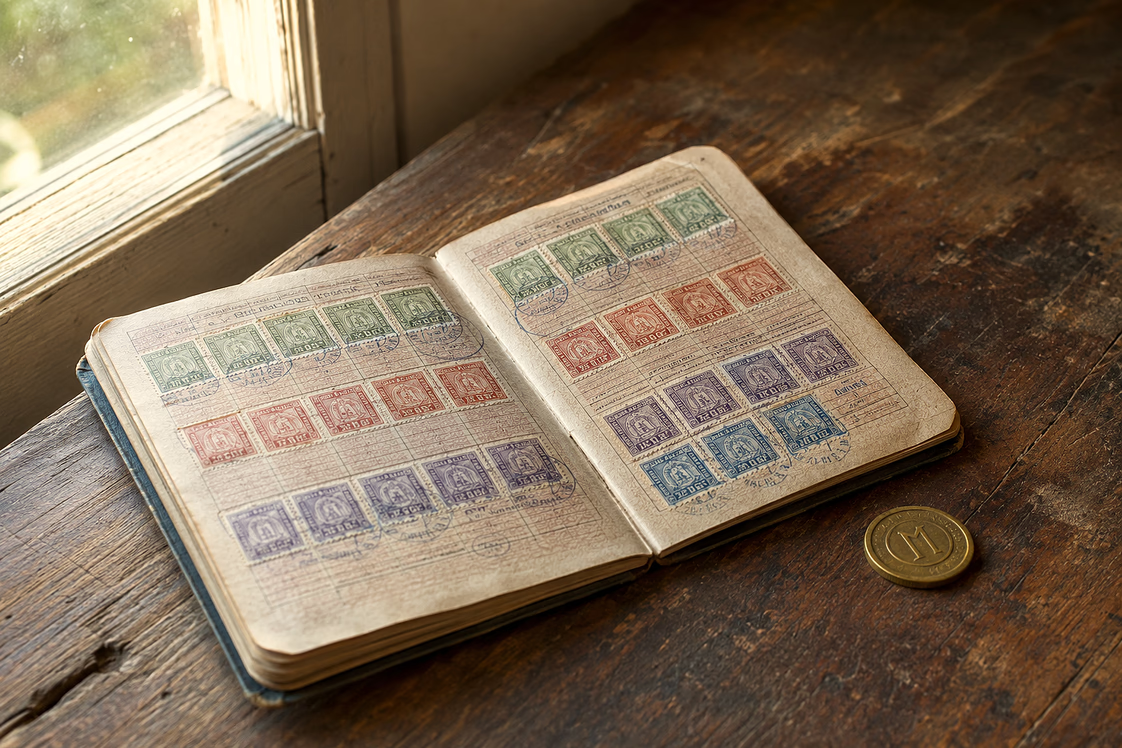
Imagine the dry clink of those metal tokens dropping into a brass box at the end of the night. By metonymy, the word moved from the piece of metal to the service itself and, finally, to the person.
Italy named the trade using the very proof of its payment.
The origin of “escort” in English: from armed protection to a social role
English took a different path with the word “escort”, a neutral term that describes the function rather than judging the person.
If we go back to 1570, the word brings to mind not evening dress or candlelit dinners, but the firm tread of an armed protection detail. It comes from the French «escorte», itself derived from the Italian «scorta» and the Vulgar Latin *excorrigere, a verb meaning to guide, straighten or set on the right path.

Around 1936, the word moved gently into the social sphere to name a person who accompanies another to a public event. It was only in 1974 that its commercial sense in the companionship sector became established[5].
“Escort” does not name the man, it names what he does, and in that respect it is closer to “acompañante” than to “gigolo”. What sets it apart is where it comes from. Beneath that patina of technical neutrality, the old idea of safeguarding, guidance and protection still remains.
German and the word “Callboy”: rank and position in the Duden dictionary
In German, the word “Callboy” offers a fascinating portrait of how the same term changes status when it crosses a border and how, sometimes, a borrowed word ends up sounding more definitive in its new home than in its language of origin.
“Call-boy” is not a German invention. Green’s Dictionary of Slang records the term in English in the sense of a male prostitute hired by telephone from 1933 in Britain, and the Duden itself acknowledges its direct lineage: „englisch call-boy, gebildet nach call-girl, Callgirl“[6].

The contrast in meanings between the Collins, the Random House and the Duden
What is revealing is the place the word occupies on the pages of each dictionary.
In the British Collins, the only definition of “callboy” refers to the theatre: the boy who tells actors that it is their turn to go on stage, the one who raps on the dressing-room doors when the moment comes. In the American Random House, the commercial sense appears in third place, after the theatrical meaning and the hotel bellboy[7].
By contrast, when the German Duden is opened, that commercial sense stands in the first and only position: „Junger Mann, der auf telefonischen Anruf hin Besuche macht oder Besucher empfängt und gegen Bezahlung deren [homo]sexuelle Wünsche befriedigt“[8].
German already had a word full of rhythm for the hired dancer, “Eintänzer”, which the Duden gives as the first sense of “Gigolo”. The same dictionary adds a second, colloquial sense, that of the young man kept by older women: there the one paying is a woman, although she is not buying a professional service but supporting the man financially. For companionship outside dance halls, however, it chose to import an Anglicism and place the commercial exchange on the main line.
The Scandinavian North: the missing symmetry in Nordic dictionaries
As the journey continues towards Europe’s northern latitudes, crossing the Baltic Sea towards Sweden, Denmark and Norway, the gap in the vocabulary appears within a single lexicographical institution. The Svenska Akademien records the word “sällskapsdam” in all three of its reference works (SAOL, SO and SAOB), and the Svensk ordbok defines it as «mest historiskt, kvinna som är anställd som sällskap åt någon», a woman employed as someone’s companion. By contrast, a search for the masculine equivalent, “sällskapsherre”, returns no result in any of the three Swedish dictionaries[9]. The same absence found in the Spanish-language reference works appears again in the North.
The Danish and Norwegian dictionaries, for their part, add a precise detail to the word “gigolo” that French lexicography never put into words. Den Danske Ordbog records under the entry “gigolo”, with the usage label nu sjældent, the definition «mand der er ansat i et forlystelsesetablissement til at danse med de kvindelige gæster», referring to a man employed in an entertainment venue to dance with female guests, and derives the term from French through «gigole». In parallel, Det Norske Akademis ordbok gives as its first sense the professional dancer paid to dance with women in restaurants and venues, reserving the second for the male sex worker. These are the only two reference works in the entire analysis that explicitly mention female clients on the dance floor[10].

For male street prostitution, Danish recorded a term of its own without restricting the sex of the person who pays. Den Danske Ordbog defines “trækkerdreng” as «ung mandlig prostitueret der skaffer sig kunder ved at trække fx på gader og offentlige toiletter eller i parker», limiting itself to describing the young man who seeks clients in streets, public toilets or parks[11].
To name contemporary commercial activity, Swedish, Danish and Norwegian relied exclusively on international borrowings. “Gigolo” was adopted from French and “escort” from English, without a vernacular word being coined for this function. In the Svenska Akademiens ordlista (SAOL), the entry “gigolo” is fixed with the definition «yrkesdansör på restaurang; man som lever på rika kvinnor», bringing together in a single line the restaurant dancer and the man who lives off wealthy women[12].
The vocabulary’s blind spot: silence when women choose
When the dictionaries of the RAE, the Treccani, the Duden, the Collins and the Svenska Akademien are laid open on the same table, a quiet, shared absence comes to light.
What happens when a language has never made room for the person who chooses and pays to be a woman?
In the reference works consulted, there is no vernacular term constructed specifically around the commercial relationship between a man and a female client. Traditional words for male prostitution either encode the orientation of the person practising the trade, or remain entirely silent on who pays.
In the Diccionario de la lengua española of the RAE, the entry “chapero” is dispatched briefly: «Homosexual masculino que ejerce la prostitución». In the Italian Treccani, “marchettaro” is recorded in slang as «omosessuale dedito alla prostituzione». In the German Duden, the definition leaves the counterpart open by making the bracketed prefix optional: [homo]sexuelle[13].

The lexical imbalance in the RAE and the silence around “acompañante”
The imbalance is also evident in the richness of stigma. Under the entry “prostituto, ta” in the RAE, the dictionary lists two masculine synonyms («puto» and «chapero») against seven feminine ones: «meretriz», «puta», «furcia», «zorra», «ramera», «fulana» and «pelandusca»[14]. And of those two masculine terms, one defines the man by his orientation rather than by the exchange, and neither says anything about who pays.
When it is a woman seeking companionship, the vocabulary becomes blurred, reaches for a loanword or retreats into silence.
As of the publication date of this article, searching for “gigoló” or “escort” in the digital edition of the RAE returns no entry. A search for “acompañante” receives the neutral response «que acompaña», followed by the sense of a marine clock or the garnish served with a dish in Equatorial Guinea, without the slightest commercial nuance[15].
The dictionaries opened for this article have a name for the man a woman keeps. For the man she chooses and pays, none of them records a native word.
The conscious choice of language: understanding words in order to inhabit them
Against this map of pages and definitions, choosing terms ceases to be a bureaucratic formality and becomes a conscious decision.
“Gigolo”, “escort”, “Callboy” and “acompañante” are not perfect equivalents. Each word was born in a different context, describes a different relationship between the person who accompanies and the person who chooses that company, and still retains part of the history that made it necessary. Changing terms therefore does not mean translating the same reality without consequence: it means shifting its nuances.
Knowing the history carried by each word allows us to inhabit them with clarity: the functional neutrality of “escort” in English, the direct precision of “Callboy” in German, or the resonances that these borrowings acquire in Spanish and Italian.
Perhaps that is why the absence found in these dictionaries is as significant as the words they do record. Naming a reality also means deciding from where it is observed, which relationship is treated as usual and which still remains at the edges of the vocabulary.
The reason this website speaks four languages is the same reason it is worth pausing over these nuances: to understand the tools of language, choose them consciously and name each encounter with the precision and respect it deserves.
Author's note
The entries cited in this article were opened one by one in the reference works for each language, rather than in second-hand repositories or other people’s summaries. The dictionaries support the dates, definitions and usage labels; the line connecting them is mine. On the derivation of “gigolo”, the dictionaries themselves disagree, and the text records that disagreement instead of choosing one version and presenting it as settled.
Cited sources
- «Gigolo» and «Gigolette» (in French). Centre National de Ressources Textuelles et Lexicales. · First attestation of "gigolo" in 1850, marked as slang and with the synonyms «proxénète» and «souteneur»; "gigolette" in 1864, probably derived from «gigue». ↩
- «Gigolette» (in Italian). Vocabolario Treccani. · «Gigolo» (in Italian). Vocabolario Treccani. · «Gigolo» (in German). Duden. · The reversed derivation is in the entry "gigolette", which traces it back to "gigolo"; the entry "gigolo" points instead to the French "giguer". The Duden proposes a French origin and closes by declaring the source unresolved, and it also records "Eintänzer" as the first sense of the word. ↩
- «Gigolo». Online Etymology Dictionary. · The word entered English in 1922 with the sense of companion or professional dancer. Supports the date only. ↩
- «Marchetta» (in Italian). Vocabolario Treccani. · Diminutive of "marca": both the contribution stamp in the work record book and the token that the madam handed over after each service. ↩
- «Escorte» (in French). CNRTL. · «Escort». Online Etymology Dictionary. · The military root and the path through the Italian «scorta»; the dates 1936 and 1974 come from the second source. ↩
- «Call, v.». Green's Dictionary of Slang. · Records "call-boy" as a male prostitute hired by telephone, with the first citation dated 1933 in Britain. ↩
- «Callboy». Collins English Dictionary. · A single page brings together three reference works: the British Collins records only one sense, the theatrical one; the Webster's New World adds the bellboy; the Random House places the commercial sense third. ↩
- «Callboy» (in German). Duden. · «Callboy» (in German). Digitales Wörterbuch der deutschen Sprache. · «Bedeutungen» (in German). Duden, notes on use. · The Duden states the English origin and, by placing the prefix in square brackets, covers both homosexual desires and sexual ones in general: in its notes on use, square brackets mark what may or may not apply, with the example «[informelles] Treffen». The DWDS, the other German reference work, defines the same word without that prefix. ↩
- «Sällskapsdam» (in Swedish). Svenska Akademiens ordböcker. · The word appears in all three reference works of the Svenska Akademien, SAOL, SO and SAOB; a search for "sällskapsherre" returns no result in any of them. ↩
- «Gigolo» (in Danish). Den Danske Ordbog. · «Gigolo» (in Norwegian). Det Norske Akademis ordbok. · Both preserve the sense of the hired dancer, marked as uncommon, and both explicitly state that the dancing was with female clients. ↩
- «Trækkerdreng» (in Danish). Den Danske Ordbog. · The definition describes where clients are sought and does not restrict the sex of the person who pays. ↩
- «Gigolo» (in Swedish). Svenska Akademiens ordlista, 2026 edition. · Brings together in a single line the professional restaurant dancer and the man who lives off wealthy women. ↩
- «Chapero» (in Spanish). Diccionario de la lengua española, RAE-ASALE. · «Marchettaro» (in Italian). Vocabolario Treccani. · Both vernacular terms are marked as slang and define the man by his homosexuality, saying nothing about the sex of the person paying. ↩
- «Prostituto, ta» (in Spanish). Diccionario de la lengua española, RAE-ASALE. · The definition is neutral as to sex; the count of two masculine synonyms against seven feminine ones comes from the list accompanying the entry. ↩
- «Acompañante» (in Spanish). Diccionario de la lengua española, RAE-ASALE. · The entry contains no commercial sense. Searches for "gigoló" and "escort" in the digital edition, carried out in August 2026, return no entry. ↩